
Choosing
Acatenango vs Pacaya: Which Volcano Hike Should You Choose?
· 5 min read
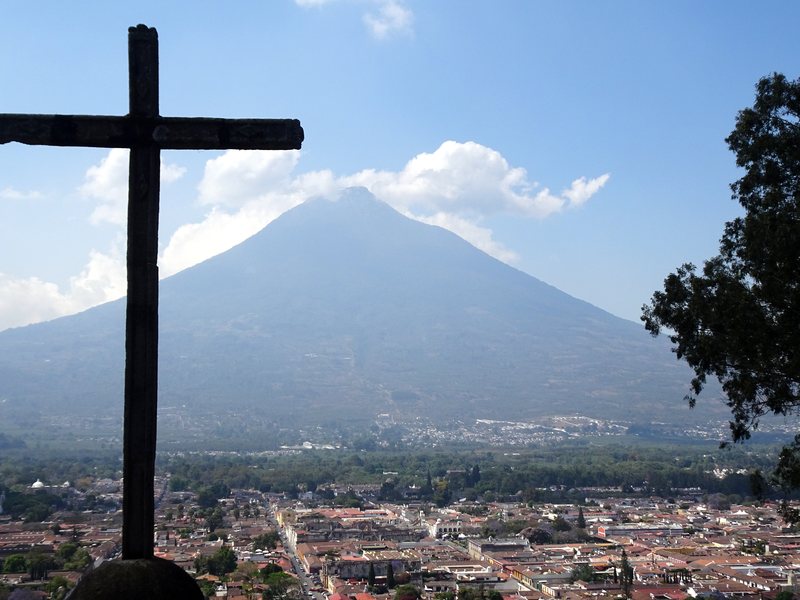
Choose Acatenango if you can manage a hard two-day hike and want to watch Volcán de Fuego erupt at night from a camp around 3,600 m. Choose Pacaya if you want an easy half day: roughly 1.5 to 2 hours up to a viewpoint on a 2,552 m volcano, back in Antigua the same day. With time, do both.
Both are volcano hikes from Antigua, and that is about where the similarity ends. One is a short walk onto old lava fields with a guide, and a horse if you want one; the other is an overnight climb that many people describe as one of the hardest days of their trip. Here they are side by side.
Acatenango vs Pacaya at a glance
| Acatenango | Pacaya | |
|---|---|---|
| Height | Summit 3,976 m; camp about 3,600 m | Summit 2,552 m; the trail ends at a viewpoint on the flank |
| Time from Antigua | 2 days, 1 night | About 5 to 6 hours door to door |
| Drive to the trailhead | About 1 hour to La Soledad | About 1 to 1.5 hours to San Francisco de Sales |
| Walking | 5–6 h up (+1,400 m) on day 1; optional 1.5–2 h summit push; 3–4 h down | About 1.5–2 h up (roughly +400 to +600 m), about 1 h down |
| Difficulty | Hard (we rate it 8/10) | Easy to moderate |
| Highlight | Fuego erupting across the valley after dark | Black lava fields, warm vents, wide views |
| Night | Camp at 2–5 °C, below freezing December–February | No night on the mountain |
| Price (2026) | Ours: $119 shared group; private $259 for one, less per head in a group. Market: about $55–330 | Shared tours about $20–60, park fee usually extra |
Pacaya figures come from operators’ 2026 listings. The Pacaya park fee is paid in cash at the entrance and has been quoted at between Q50 and Q100 for foreign visitors, so bring quetzales.
Which is harder, Acatenango or Pacaya?
Acatenango, by a wide margin. Day one climbs about 1,400 m over 5 to 6 hours, finishing on loose volcanic scree where every step slides back, and you then sleep at altitude in the cold. If you can walk six hours on hilly ground with a daypack, you can do it, but it is a real effort. Our honest guide to how hard Acatenango is breaks it down.
Pacaya is a steady uphill walk on a wide path, finishing on gravel and old lava. Most reasonably active people manage it without trouble, children included, and horses wait at the start for anyone who would rather ride part of the way. The trade-off is that Pacaya does not take you near the top: you stop on the flank, below the active cone.
Will you see lava?
On Acatenango, you will see Fuego. Its eruptions are near-continuous, and from camp after dark they show as orange bursts above the crater, sometimes with lava flowing down its flanks. Clouds hide it on some nights, but the odds are good, especially in the dry season. Here is what the night is really like.
On Pacaya, maybe not. Its activity comes and goes: in some years lava has flowed close to the trail, in others there is nothing but warm rock and steam, and many photos still used to sell Pacaya tours show eruptions from years ago. What you can count on is the landscape of black lava fields, vents warm enough to toast a marshmallow, and wide views in clear weather. If lava is the point, check the latest INSIVUMEH bulletin before you book.
Which is better for families or a short stay?
Pacaya. It fits into a morning or an afternoon, needs no camping kit, and suits children and anyone who does not want to spend a night near freezing. We do not recommend Acatenango for children under 12, who usually find the climb very long, or for anyone pregnant or with heart, back or untreated blood-pressure conditions.
If you only have one free day in Antigua, Pacaya is the realistic choice. Acatenango needs two days, plus ideally two nights in Antigua beforehand to acclimatise.
Which has the better views?
On a clear day both look out over Guatemala’s chain of volcanoes. From Acatenango’s summit at sunrise you look straight down on Fuego, across to Volcán de Agua, and over valleys often filled with cloud below you. Pacaya’s viewpoint is lower and further east, with Lake Amatitlán below and Agua to the west. Acatenango wins on drama; Pacaya wins on effort per view.
What should you bring for each?
For Pacaya: walking shoes with grip, a light jacket for the wind on the ridge, water, sunscreen, cash for the park fee and a few marshmallows, and a headlamp if you take an afternoon tour that comes down at dusk. For Acatenango the list is longer because of the night: warm layers, a waterproof shell, 4 litres of water and a headlamp with spare batteries. It is all in what to pack for Acatenango.
Can you do both?
Yes, and plenty of travellers do. The order matters: Pacaya first, Acatenango after. A Pacaya tour on your second day in Antigua tells you how your legs and lungs feel above 2,000 m without committing you to a night at 3,600 m. A plan that works:
- Day 1: arrive in Antigua, walk the town, sleep.
- Day 2: Pacaya on a morning or afternoon tour, back for dinner.
- Days 3–4: the Acatenango overnight, back in Antigua around 13:00–14:00 on day 4.
- Day 5: move on to the lake, the coast or the airport, or simply rest your legs.
So which one should you choose?
If watching an erupting volcano from a mountain camp is the reason you came to Guatemala, nothing replaces Acatenango; Pacaya is a pleasant half day, not a substitute. If time, fitness or family make an overnight unrealistic, Pacaya gives you a real volcano without the cold night. And if you are torn about the overnight itself, read our comparison of the one-day and overnight Acatenango.
Ready for the big one? Book the Acatenango overnight hike, or first see what the price includes.
Frequently asked questions
- Is Pacaya easier than Acatenango?
- Much easier. Pacaya is about 1.5 to 2 hours up, with a few hundred metres of climbing and no night on the mountain. Acatenango climbs about 1,400 m on day one and camps around 3,600 m.
- Can you see Fuego erupt from Pacaya?
- Only from far away, if at all. On a clear day you may see Fuego in the distance beyond Volcán de Agua. The close view of its night eruptions belongs to Acatenango’s camp, about 3 km from Fuego’s crater.
- Is Pacaya good for kids?
- Yes. Most children who walk regularly manage it, and horses are available for part of the way. Acatenango is not recommended for children under 12.
- Should I do Pacaya before Acatenango?
- If you have time, yes. Pacaya is a gentle test of how you feel above 2,000 m and of your legs on volcanic gravel, a day or two before the much harder Acatenango.
- How much does Pacaya cost compared with Acatenango?
- Shared Pacaya tours from Antigua cost roughly $20 to $60 in 2026, with the park fee usually paid separately. Acatenango overnight tours run about $55 to $330; ours costs $119 per person in a shared group.